

When someone feels unsafe because of threats, harassment, or violence within a family relationship, the law allows a court to step in quickly.
In Alberta, one of the most immediate legal protections available is an Emergency Protection Order (EPO). These orders are meant to provide short-term safety in urgent family violence situations while the court decides what should happen next.
Understanding how an Emergency Protection Order works in Alberta can help people navigate a difficult and often stressful situation.
What Is an Emergency Protection Order in Alberta?
An Emergency Protection Order (EPO) is intended to provide immediate protection in situations involving family violence.
Under Alberta’s Protection Against Family Violence Act, an EPO may be granted when:
- family violence has occurred
- there is reason to believe the violence could continue
- the situation requires urgent protection
If granted, an EPO can include conditions to help protect someone’s safety. These conditions may include:
- requiring someone to stay away from the protected person
- prohibiting contact or communication
- requiring a person to leave the family home
- allowing police to help someone collect their belongings
- preventing someone from going to certain places, such as a home, workplace, or school
These orders are meant to create an immediate period of safety while the court reviews the situation more fully.
Who Qualifies for an Emergency Protection Order in Alberta?
Emergency Protection Orders are only available in situations involving family violence between family members.
Under Alberta’s Protection Against Family Violence Act, “family members” can include:
- people who are married or were married
- people in an adult interdependent relationship
- people who live together or previously lived together in an intimate relationship
- parents of the same child
- relatives by blood, marriage, adoption, or adult interdependent relationship
- children in the care of a family member
Because the law focuses on family relationships, an Emergency Protection Order may not apply to neighbours, roommates, or people who are dating but do not live together.
In those situations, other legal options, such as Restraining Orders, may be available.
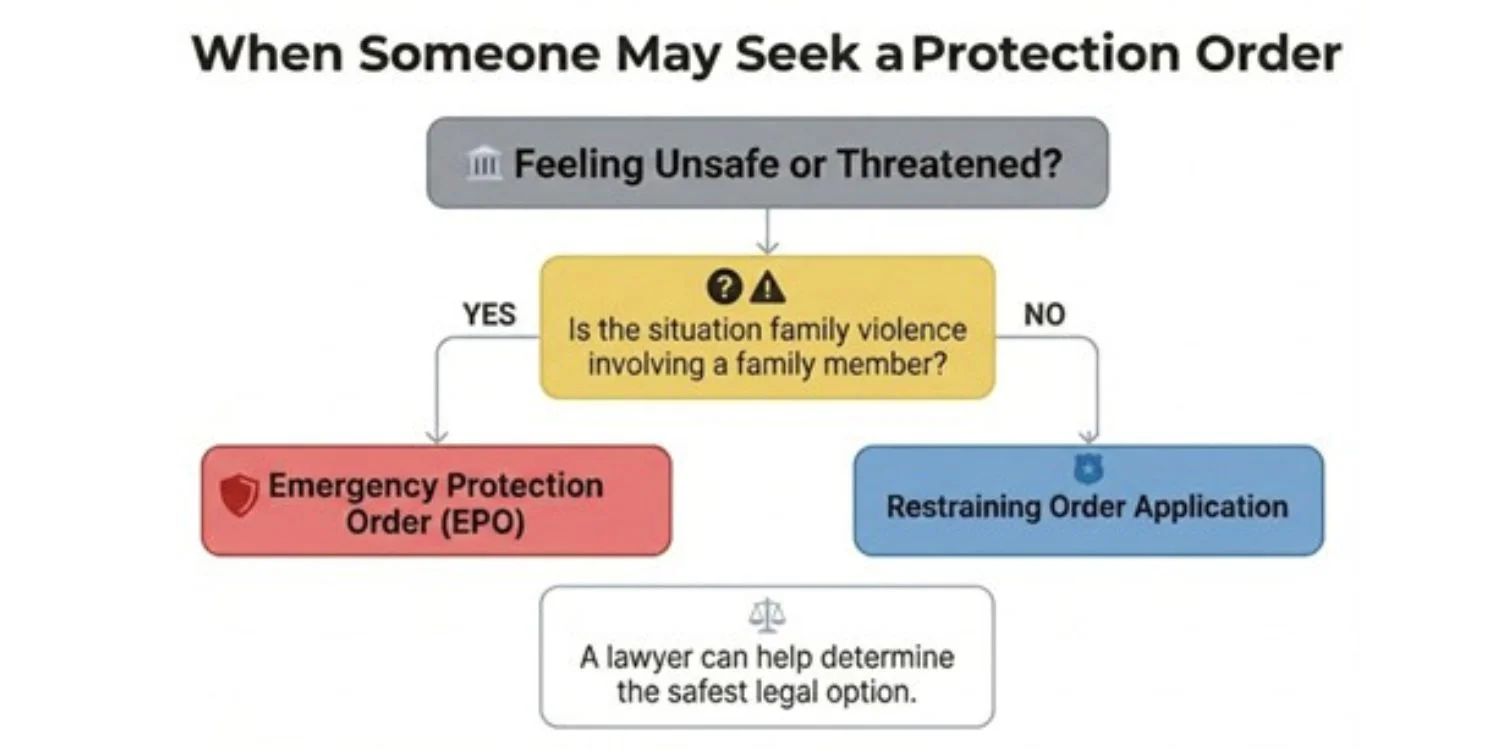
How people may end up seeking a protection order
How Are Emergency Protection Orders Different From Restraining Orders?
People often search online for information about both Emergency Protection Orders and Restraining Orders. While both can restrict contact and protect someone’s safety, they are used in different situations.
Emergency Protection Orders are typically used in urgent family violence situations, while Restraining Orders may be used in a broader range of disputes, including harassment or neighbour conflicts.
| Feature | Emergency Protection Order | Restraining Order |
| Applies to | Family members (spouses, partners, relatives, cohabitants) | Can apply to neighbours, roommates, or others |
| Urgency | Designed for urgent, immediate protection | May be sought through regular court process |
| Who grants it | Justice of the Peace (can be granted same day) | Court of King’s Bench (scheduled application) |
| Review | Mandatory review within 9 working days | Varies depending on the order |
| Can remove someone from home | Yes | Depends on the specific order |
| Duration | Temporary, reviewed at hearing | Varies, may be longer term |
What Evidence Can Be Used to Support an Emergency Protection Order?
One of the most common questions people ask is what evidence courts consider when deciding whether to grant an Emergency Protection Order in Alberta.
Physical violence is not the only factor courts may consider. Evidence may include:
- threatening text messages or emails
- verbal threats
- harassment or stalking
- patterns of controlling behaviour
- past incidents between the parties
- witness statements
- police attendance at the home
- escalating conflict between family members
The court looks at whether there is a real risk to someone’s safety. The court may also look at the history of family violence, controlling behaviour, recent incidence of violence and whether the situation appears to be escalating.
How an Emergency Protection Order Works
How Quickly Can an Emergency Protection Order Be Granted?
In some cases, the order may be issued by a justice of the peace when immediate protection is required.
In certain circumstances, police may also become involved and apply for an order to protect someone who is experiencing family violence.
Once granted, the order takes effect quickly and can be enforced by police.
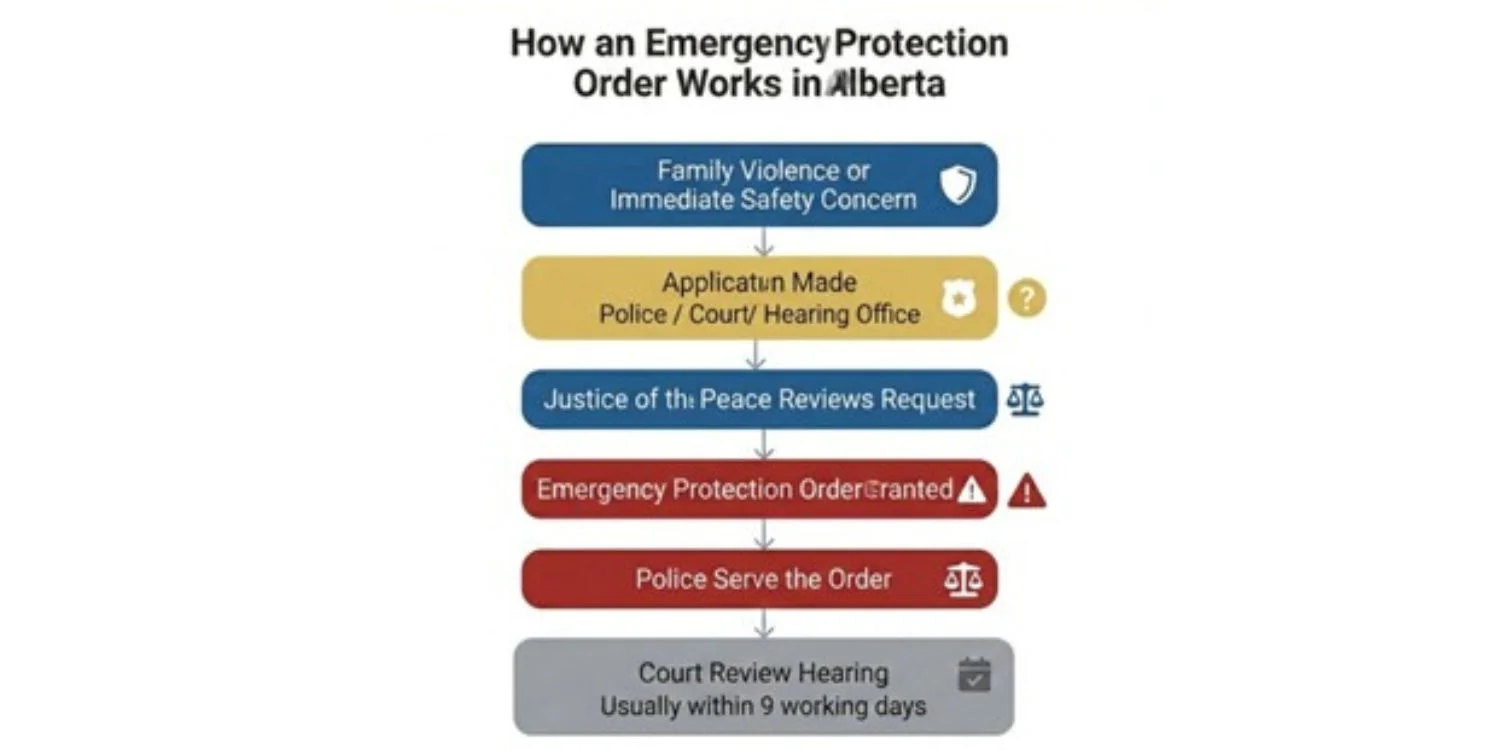
Overview of the Emergency Protection Order process in Alberta.
What Happens at an EPO Review Hearing?
An Emergency Protection Order is not automatically permanent.
Under Alberta law, every EPO must be reviewed by a judge of the Court of King’s Bench within nine working days of the order being granted. This court appearance is commonly referred to as an EPO review hearing.
At the review hearing, the court reviews the evidence and decides what should happen next. Possible outcomes include:
- confirming the order so that it continues
- varying or modifying the terms of the order
- cancelling the order
- directing that a further hearing take place
Both parties may have the opportunity to provide information to the court before a final decision is made.
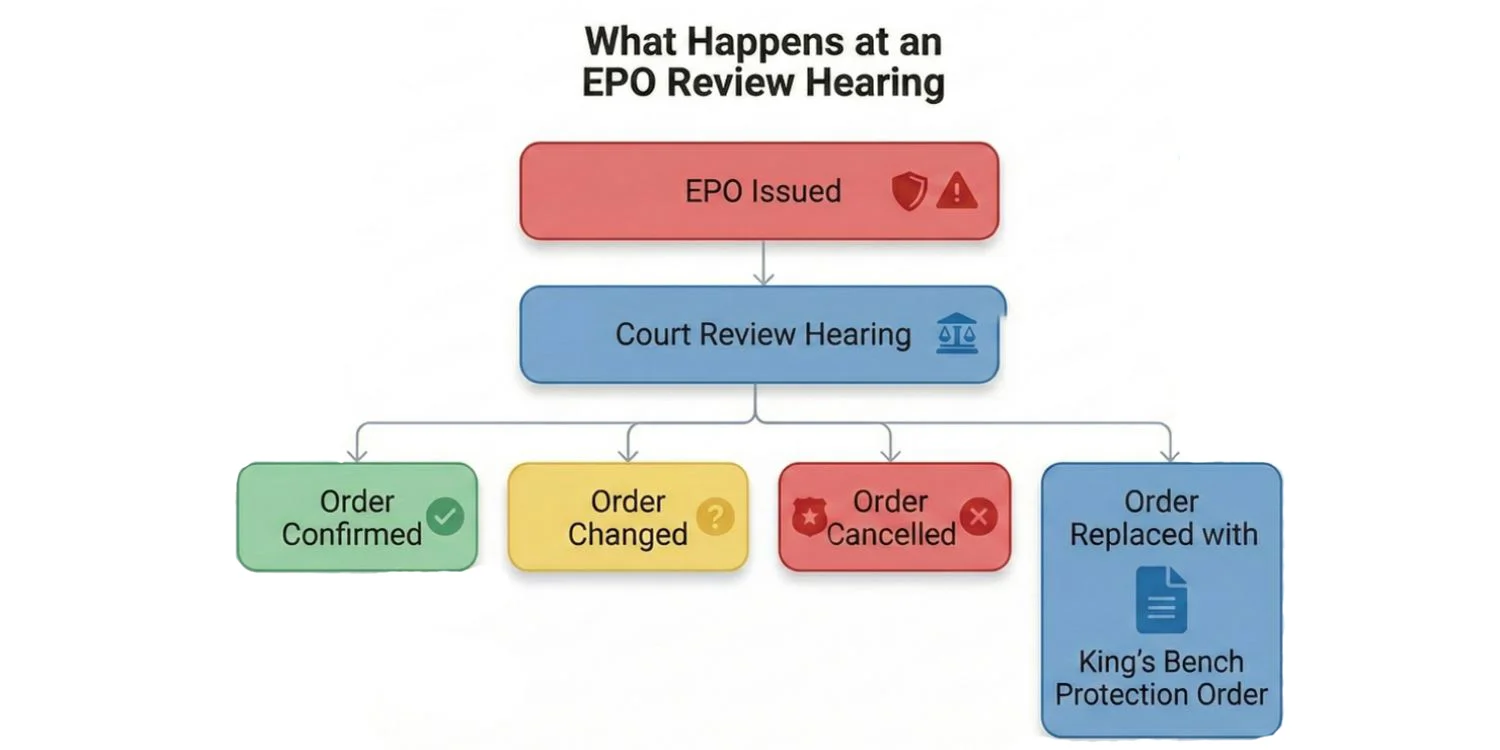
Possible outcomes at an EPO review hearing.
Can Someone Challenge an Emergency Protection Order?
Being served with an Emergency Protection Order does not necessarily mean it will remain in place.
The person named in the order can attend the review hearing and explain their position to the court. The judge will consider all available evidence before deciding whether the order should continue, be changed, or be cancelled.
Can an EPO Remove Someone From the Family Home?
An EPO may:
- require one person to leave the home
- grant the other person exclusive possession of the residence
- allow police to help someone collect their belongings
These steps are meant to create immediate safety in situations involving family violence.
However, an EPO does not permanently determine property rights or ownership of the home. Longer-term property issues are usually addressed in separate legal proceedings.
Does an Emergency Protection Order Affect Contact With Children?
An EPO may affect how parents interact with each other when children are involved. For example, the order may:
- restrict communication between the parties
- limit contact between individuals named in the order
- change how parents communicate about their children
Emergency Protection Orders are short-term safety measures. Long-term parenting arrangements, decision-making authority, and parenting time are typically addressed through separate family court proceedings.
What Happens If a Protection Order Is Ignored?
What Counts as Breaching an Emergency Protection Order?
Examples of actions that may break an Emergency Protection Order include:
- contacting the protected person directly
- sending messages through friends or family members
- attending locations that the order prohibits
- attempting to communicate in ways that violate the terms of the order
Breaching a protection order is a serious legal matter.
Breaching a protection order can also have criminal consequences. When someone violates the terms of an Emergency Protection Order, police may lay charges under Alberta’s Protection Against Family Violence Act. In some circumstances, additional criminal charges may also apply depending on what occurred.
Convictions for breaching protection orders can result in fines, probation, or jail sentences. Repeat breaches can carry increasingly serious penalties.
Anyone who is subject to an EPO should take the conditions of the order very seriously.
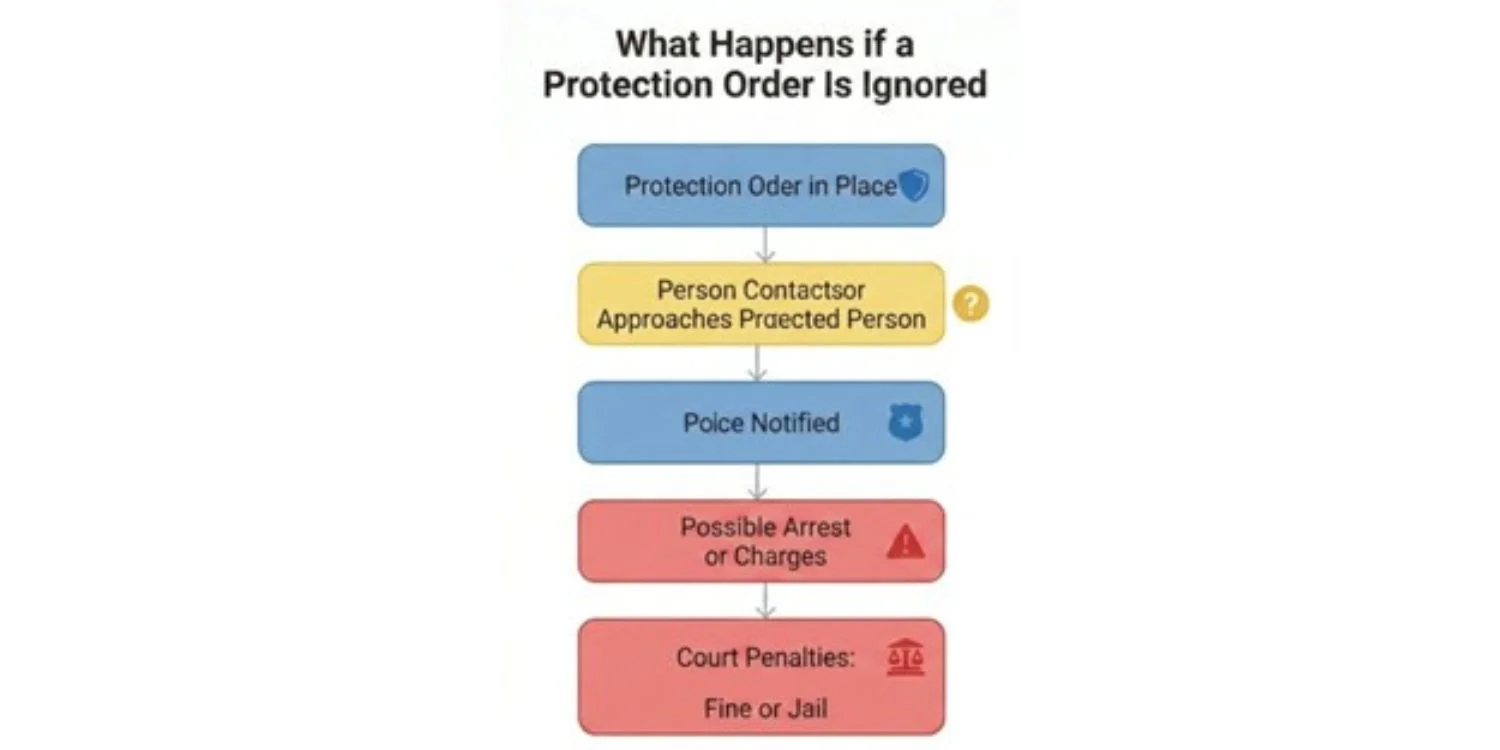
Legal consequences if a protection order is violated.
How Long Does an Emergency Protection Order Last?
An Emergency Protection Order is intended to provide temporary protection. The initial order remains in place until the review hearing, where the court decides whether it should continue.
If the order is confirmed or replaced with another protection order, it may remain in effect for a longer period depending on the court’s decision.
Can an Emergency Protection Order Be Extended Beyond One Year?
In most cases, protection orders issued under Alberta’s family violence legislation cannot last longer than one year at a time.
However, the court has the authority to extend a protection order if continued protection is necessary. Extensions must be granted by the court and are typically considered before the order expires.
If circumstances change or safety concerns remain, the court may grant additional protection orders for further periods.
It may help to speak with a lawyer before the order expires if protection may still be needed.
When to Speak With a Lawyer
Emergency Protection Order situations can move quickly and may affect housing, family relationships, and future court proceedings.
You may want to speak with a lawyer if you:
- have been served with an Emergency Protection Order
- are preparing for an EPO review hearing
- are dealing with housing issues related to the order
- have questions about parenting arrangements affected by the order
If you are dealing with an Emergency Protection Order in Calgary or elsewhere in Alberta, speaking with a lawyer can help you understand your rights and the next steps available to you.
–
Our firm regularly assists individuals navigating protection order matters and EPO review hearings throughout Calgary and Alberta. Contact us at 403-300-5297 or info@lawsnbeyond.com.